White Bear Lake

Mark Twain wrote about the legend of White Bear
Lake in his book Life On the Mississippi. Here is an excerpt from
that book:
Near St. Paul and Minneapolis are several points
of interest—Fort Snelling, a fortress occupying a river-bluff a hundred
feet high; the falls of Minnehaha, White-bear Lake, and so forth.
The beautiful falls of Minnehaha are sufficiently
celebrated—they do not need a lift from me, in that direction.
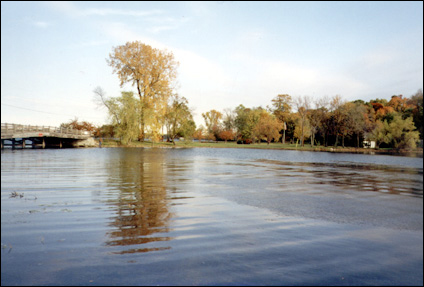
Manitou Island Today
The White-bear
Lake is less known. It is a lovely sheet of water, and is being utilized
as a summer resort by the wealth and fashion of the State. It has its club-house,
and its hotel, with the modern improvements and conveniences; its fine summer
residences; and plenty of fishing, hunting, and pleasant drives. There are
a dozen minor summer resorts around about St. Paul and Minneapolis, but
the White-bear Lake is the resort. Connected with White-bear Lake
is a most idiotic Indian legend. I would resist the temptation to print
it here, if I could, but the task is beyond my strength. The guide-book
names the preserver of the legend, and compliments his 'facile pen.' Without
further comment or delay then, let us turn the said facile pen loose upon
the reader—
A LEGEND OF WHITE-BEAR LAKE.
Every spring, for perhaps a century, or as long
as there has been a nation of red men, an island in the middle of White-bear
Lake has been visited by a band of Indians for the purpose of making maple
sugar.
Tradition says that many springs ago, while upon
this island, a young warrior loved and wooed the daughter of his chief,
and it is said, also, the maiden loved the warrior. He had again and again
been refused her hand by her parents, the old chief alleging that he was
no brave, and his old consort called him a woman!
The sun had again set upon the 'sugar-bush,' and
the bright moon rose high in the bright blue heavens, when the young warrior
took down his flute and went out alone, once more to sing the story of
his love, the mild breeze gently moved the two gay feathers in his head-dress,
and as he mounted on the trunk of a leaning tree, the damp snow fell from
his feet heavily. As he raised his flute to his lips, his blanket slipped
from his well-formed shoulders, and lay partly on the snow beneath. He
began his weird, wild love-song, but soon felt that he was cold, and as
he reached back for his blanket, some unseen hand laid it gently on his
shoulders; it was the hand of his love, his guardian angel. She took her
place beside him, and for the present they were happy; for the Indian has
a heart to love, and in this pride he is as noble as in his own freedom,
which makes him the child of the forest.
As the legend runs, a large white-bear, thinking,
perhaps, that polar snows and dismal winter weather extended everywhere,
took up his journey southward. He at length approached the northern shore
of the lake which now bears his name, walked down the bank and made his
way noiselessly through the deep heavy snow toward the island. It was the
same spring ensuing that the lovers met. They had left their first retreat,
and were now seated among the branches of a large elm which hung far over
the lake. (The same tree is still standing, and excites universal curiosity
and interest.) For fear of being detected, they talked almost in a whisper,
and now, that they might get back to camp in good time and thereby avoid
suspicion, they were just rising to return, when the maiden uttered a shriek
which was heard at the camp, and bounding toward the young brave, she caught
his blanket, but missed the direction of her foot and fell, bearing the
blanket with her into the great arms of the ferocious monster. Instantly
every man, woman, and child of the band were upon the bank, but all unarmed.
Cries and wailings went up from every mouth. What was to be done'? In the
meantime this white and savage beast held the breathless maiden in his
huge grasp, and fondled with his precious prey as if he were used to scenes
like this. One deafening yell from the lover warrior is heard above the
cries of hundreds of his tribe, and dashing away to his wigwam he grasps
his faithful knife, returns almost at a single bound to the scene of fear
and fright, rushes out along the leaning tree to the spot where his treasure
fell, and springing with the fury of a mad panther, pounced upon his prey.
The animal turned, and with one stroke of his huge paw brought the lovers
heart to heart, but the next moment the warrior, with one plunge of the
blade of his knife, opened the crimson sluices of death, and the dying
bear relaxed his hold.
That night there was no more sleep for the band
or the lovers, and as the young and the old danced about the carcass of
the dead monster, the gallant warrior was presented with another plume,
and ere another moon had set he had a living treasure added to his heart.
Their children for many years played upon the skin of the white-bear—from
which the lake derives its name—and the maiden and the brave remembered
long the fearful scene and rescue that made them one, for Kis-se-me-pa
and Ka-go-ka could never forget their fearful encounter with the huge monster
that came so near sending them to the happy hunting-ground.
It is a perplexing
business. First, she fell down out of the tree—she and the blanket; and
the bear caught her and fondled her—her and the blanket; then she fell
up into the tree again—leaving the blanket; meantime the lover goes war-whooping
home and comes back 'heeled,' climbs the tree, jumps down on the bear, the
girl jumps down after him—apparently, for she was up the tree—resumes
her place in the bear's arms along with the blanket, the lover rams his
knife into the bear, and saves—whom, the blanket? No—nothing of the sort.
You get yourself all worked up and excited about that blanket, and then
all of a sudden, just when a happy climax seems imminent you are let down
flat—nothing saved but the girl. Whereas, one is not interested in the
girl; she is not the prominent feature of the legend. Nevertheless, there
you are left, and there you must remain; for if you live a thousand years
you will never know who got the blanket. A dead man could get up a better
legend than this one. I don't mean a fresh dead man either; I mean a man
that's been dead weeks and weeks.
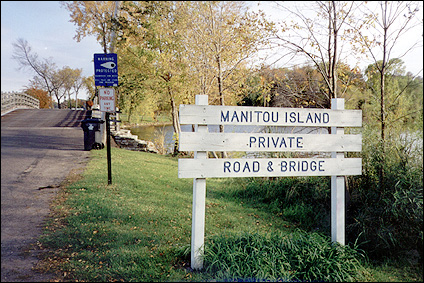
The hotel Mark Twain mentions is gone. The Dakotas
are also long gone. Manitou Island now is the site of expensive homes and
access is restricted to home owners and their guests.
Driving around White Bear Lake today you will see many references to polar bears, including lawn statues, windshield stickers, business names, and even a giant polar bear fronting the local Chevrolet dealer. Personally, I think that the bear, assuming it was actually seen, was not a polar bear, but an unusually colored black bear, perhaps an albino. I doubt very much that polar bears ever made it this far south.