Oscar Ludwig Olson
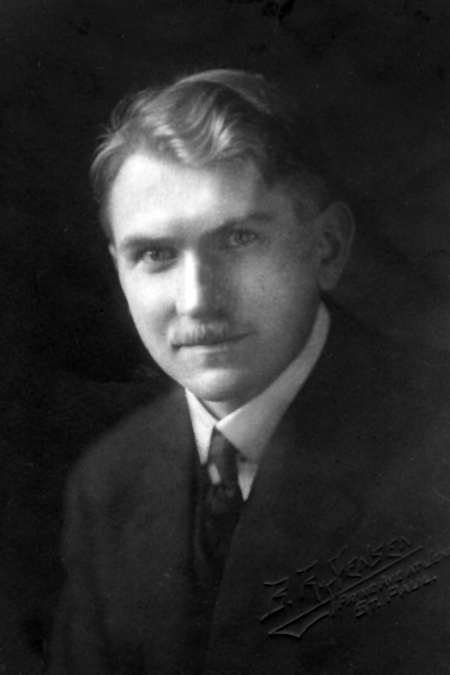
In the little humble home of August and Sophie Olson, of Töllsjö,
in the province of Västergötland, Sweden, there were born their
ten children, of whom the third was Oscar Ludwig (born Aug. 6, 1887). The
earthly possessions in this home were very meager, but there prevailed
a wealth of spiritual joy and consequent reliance on the Lord's nearness
and help for time and eternity.
They had but a small tract of land on which they raised their own potatoes,
usually a cow or two, a few sheep and pigs. An abundance of wild berries,
such as lingonberries, blueberries and raspberries, were gathered by the
children and sold. Then too the children and parents combined their efforts
during every spare moment for the making of baskets and rugs, using bast
as the material. These items, as in the case of berries, would be bartered
for staple groceries. The children would often try their luck at fishing,
doing so by means of nets which they would put out at night to remain in
the water till morning. An example of the trust that the family placed
in the Lord-for all matters-is the prayer that Oscar's older brother offered
when going fishing: "Lord, help us that we don't lose them."
In order to somewhat augment the scanty output from their little farm,
Father Olson would go away to do heavy labor such as grubbing by hand,
being gone sometimes as long as three weeks at a time. He would see that
the family was well supplied with wood, at least, before he left and then
when turning the doorknob to leave he would very reverently whisper "I
Jesu namn" (In Jesus' name). Another recollection from
the home which the children often mention is the manner in which the whole
family would kneel in prayer at a certain old bench or couch. Oscar also
well remembered how so often there was but little in the house to eat,
and especially did one incident remain in his mind, namely when the oatmeal
porridge boiled over and how bitterly his mother wept about it. He also
speaks of the times when he and his brother would go off by themselves
at school lunch time, because they had nothing but plain bread without
any spreads such as the other children had. By isolating themselves they
avoided the ridicule from the other children.
So as to somewhat lighten the financial load at home, and with the thought
that it might possibly be an adventure for Oscar, the parents arranged
to have him live with an uncle and aunt some 20 miles from home. (That
distance doesn't seem great these days with modern conveniences, but was
too long then so he very seldom got home.) This was done when he was only
ten years old, and after that he never had the opportunity to live in his
parental home. While these relatives had a little more financial means,
it was nevertheless not "home" for Oscar, causing him much homesickness.
That is very understandable, coming from a home with so many children to
one where there were none. He had to work hard for these people for no
remuneration other than food, shelter and absolute clothing necessities.
Speaking of walking long distances, he had to walk 14 miles twice a week
for Confirmation instruction.
A couple of years later he was transferred to the home of another aunt
and uncle, who lived close to the school. There too he had to work very
hard. He was also given the job of ringing the church bell for Sunday worship
and weekdays-a thing he much enjoyed and for which he was to receive two
crowns (28¢) a month. The relatives with whom he had his home always
seemed to manage to "borrow" this small sum from him but very
conveniently to their benefit, forgot ever to repay. This uncle was a cobbler
so Oscar was given a chance to help him with that work and to learn the
trade. At that time the cobblers in Sweden did the work in the homes of
their customers. Oscar therefore would quite often accompany his uncle
on such trips, a thing he really looked forward to.
In 1904 a relative from St. Paul, Minnesota, visited Oscar's parental
home and he induced Oscar's eldest brother, Carl, to go to America. In
1905 Oscar also decided to venture out for America, and he was then employed
by this relative who was operating a shoe store and shoe repair shop in
St. Paul, at 970 Payne Avenue, between Case and Jenks. He continued working
there until 1911 when the relative sold the business to Oscar, who was
then too inexperienced in buying to properly evaluate the stock, so he
paid an exorbitant price for a rather depleted stock, but he struggled
along bravely with it even in the face of the soon ensuing inflation and
deflation effects of World War I.
From practically the first Sunday that he was in St. Paul, he was a
faithful attendant at the Gustavus Adolphus Lutheran Church of St. Paul.
During the ensuing 25 years he had much experience in the various branches
of the church, serving as Sunday School Superintendent, deacon, choir member,
etc., and very often he was called upon to assist in the pulpit. In 1922
the Gustavus Adolphus Church started a branch Sunday School in the Phalen
Park District, and Oscar became Superintendent there for a few years, and
also conducted occasional Sunday morning worship services there. From this
meager beginning developed the organization of the Mt. Carmel Lutheran
Church.
Oscar's desire for many years had been to get into full-time service
as pastor, but with family responsibilities, store ownership, and lack
of adequate funds, it seemed so impossible. At a St. Paul District meeting
a recommendation was sent to the Minnesota Conference for their consideration
of Oscar as candidate for a two-year course at the seminary. This carried,
so in September, 1928, he left his business and his wife and four children
for matriculation at Augustana Seminary, Rock Island, Illinois. It was
not an easy matter for him to thus replant himself into intensive study
after so many years in an entirely different field. He tried to operate
his store by "remote control" for a year and a half after entering
the seminary. He would come home every other weekend, taking the train
on Friday evening from Rock Island, spend Saturday morning in checking
up the stock and other matters in connection with the store, work at the
store till about midnight Saturday and then preach on Sunday at South St.
Paul, returning by train to Rock Island that evening. The South St. Paul
pastor, who was ailing, had him come on whatever Sundays he was able and
then would assign a substitute the other Sundays. It meant that Oscar came
every other Sunday. Early in 1930 Oscar sold the store at quite a sacrifice,
but it was of course necessary to dispose of it before ordination. During
Oscar's two years at Rock Island, Mrs. Olson worked half days in order
to try to help out on the budget.
June 8, 1930, was indeed a happy day, for it was then Oscar was ordained
at Rock Island on a call to a mission field in Duluth, Minnesota. This
entailed serving four groups. The First Lutheran Church of Arnold was the
only organized congregation in the group. They had only a grass-overgrown
basement, the remains from the 1918 widespread fire in that territory.
Oscar immediately set about encouraging the small nucleus to consider building
a superstructure. The result was the dedication of a lovely little brick
church in the summer of 1931. On Duluth Heights there were two meeting
places only two miles apart. It would seem unfeasible to have two meeting
places so close to one another, but at that time-Depression days-transportation
facilities were at a minimum. Quite a number of children lived in that
territory so it was necessary to make it as convenient as possible for
them. On "Lower Duluth Heights" there was a house that was used
for Sunday School and occasional midweek and Sunday services; on Swan Lake
Road ("Upper Duluth Heights") a small chapel was erected and
ready for use by Christmas. It was a touching sight to note the interest
of the people; they would carry their own chairs from home-funds were too
meager to buy pews or chairs for the chapel. In the 1940's these two groups
merged, forming Holy Cross Church. A church had been built in 1935 on the
Lower Heights and after the two groups merged the little chapel on Swan
Lake Road was moved to Woodland, the fourth part of the parish. Until this
chapel was moved to Woodland, Sunday School and worship services were conducted
in an upstairs location above a hardware store. This "Woodland area"
group became the Concordia Lutheran Church.
In 1938, Oscar moved to Moose Lake, Minnesota, there also accepting
a parish with four preaching places. After a year, however, two of the
congregations agreed to merge, razing both their old churches and building
a new one midway between the two fomer ones. That was in Denham (p.o. Sturgeon
Lake), Minnesota. The Blomskog Church in that parish was extensively remodelled.
After six happy years in that field, the family moved to Vancouver,
B.C., Canada, on a joint call from the Home Mission Board and the First
Lutheran Church of Vancouver. There was a splendid opportunity to serve
the many people of Swedish descent who somehow claimed the Augustana Church
(original name "First Lutheran") theirs despite the fact that
they had no membership there, and seldom attended or contributed. Because
of its downtown location it also served well for the seafarers of coastal
Vancouver. The congregation had sold their old downtown location when Oscar
arrived, so it was necessary to procure a new site, building permit, material
and funds. Many were the restrictions and disappointments during those
wartime days, and with net resources of only $5,000 after the sale of the
old church. One example of the gloomy thoughts of many: "I hear you
couldn't get the lot you wanted, and if you had gotten that you wouldn't
have been able to get the permit, and if the permit, then not the necessary
material, and if the material you would never have a congregation of any
number, so it's just as well that it is nipped in the bud." Finally,
however, in early 1947 a lovely sanctuary had been completed. Though the
experience there was very difficult it was a challenge and something which
added much to the total program of his life.
In 1948 Oscar accepted a call to Mora, Minnesota, where he remained
for nine years until he reached the so-called retirement age of 70. Just
as he had announced his anticipated retirement he received a call from
the Messiah Church, Chicago, to become visiting pastor, and also received
a call from the Holmes City/Oscar Lake parish, Minnesota. He accepted the
latter, spending his next ten years in service there. During eight of those
years he also served as chaplain of the Bethany Old People's Home, Alexandria,
Minnesota. At age 80, he moved back to Mora, Minnesota, to retire, but
served 14 Sundays, preaching at McGregor-Palisade, and seven Sundays at
Grasston-Brunswick. He also served two days a week as visiting pastor,
for three months, or till health permitted no more regular duties. He often
conducted services after his 82nd birthday. He loved to sing, and his songs
brought enjoyment to many. The number of songs he had memorized was amazing.
Oscar and Josie celebrated their 50th wedding anniversary in Holmes
City, hosted by the Holmes City/Oscar Lake parish, with the Olsons' children
and grandchildren furnishing the greater part of the program.
Oscar suffered a series of strokes after his retirement
and entered a nursing home in Mora. Later he suffered a stroke which resulted
in the loss of speech. Oscar died on June 10, 1973, in Mora, Minnesota.